
Finding Residents in Orange
The useful question is not simply whether a name appears. It is what relationship the record describes. The Orange County Assessor can connect a parcel to assessment ownership and a mailing address. The Clerk-Recorder index can identify parties to a deed, lien, or release. The Superior Court can show a party role and case event. OC Vote can confirm a voter’s own registration dashboard, but it is not a public street list. The Orange Public Library & History Center adds older households, buildings, photographs, and newspaper clues.
Those sources answer different questions. An assessed owner may not be the person who stays at the address. A deed party may be a trust or a former owner. A court name can match the wrong person. A directory entry may describe a household only for the year it was canvassed. Treat each result as one link in a record trail, then use a second independent anchor such as an APN, case number, spouse, middle initial, business affiliation, or date.
- Normalize the name or address, including directional words, suffixes, and alternate spellings.
- Use the Orange County Assessor or OC Public Works map to establish the parcel and APN.
- Compare the parcel lead with the Clerk-Recorder grantor-grantee index and its recording date.
- Use the relevant court, license, business, vital, or historical source for the question at hand.
- Ask the custodian for a copy or bounded public-record request when the index stops short of the needed record.
For a whole named street, the address workflow belongs in the Orange street directory. For a past household, the historical shelf and year-by-year method matter more than a current roll.
Orange Residents Directory Offices
Orange is a city in Orange County, while Santa Ana is the county seat and the main destination for county recording, elections, assessment, and Superior Court work. City Hall remains important for city-created records, permits, planning material, and public-record requests. Keeping that geography straight prevents a city address from being sent to the wrong custodian.
The office cards below describe the first stop for common Orange record questions. A portal can locate an index entry, but the office that holds the record controls copies, redactions, retention, and access decisions.
Orange County Clerk-Recorder
601 N. Ross Street
Santa Ana, CA 92701
(714) 834-2500
Online grantor-grantee index
Orange County Assessor
Secured-property ownership, APN, situs, values, and characteristics.
Use the dependable address or APN keys rather than treating a name browse as unrestricted.
Online secured-property search
Orange County Registrar of Voters
1300 S. Grand Ave., Building C
Santa Ana, CA 92705
Self-lookup is for the voter. Controlled data products require a qualifying purpose and application.
Self-service OC Vote lookup
Orange Property Records for Residents
The parcel is the best bridge between a current address and the county record systems. Enter a street number and street name in the Orange County Assessor secured-property search, or use the APN when one is known. The result can expose the situs, owner or assessee display, mailing address, tax context, values, and property characteristics. It can also link toward tax and map details. Assessment data describes the roll. It does not replace a deed or prove who lives at the parcel.
OC Public Works adds a map view. The OC Interactive Map lets a researcher click a parcel, read its APN, and inspect nearby parcel shapes. The map is a discovery aid, not a survey. A street search becomes more reliable when the APN and legal description stay with the address through every later lookup.
The assessor fields make the difference between a useful search and a vague one:
| Street number | Text key for the situs address. |
|---|---|
| Street name | Text key; preserve directional prefixes and spelling variants. |
| City or community | Selector or text field when offered; a postal city is not always a city limit. |
| APN | Formatted numeric parcel key and the safest exact match. |
| Result fields | APN, situs, owner or assessee, mailing address, legal-description fragment, land and improvement values, use code, year built, and related tax or GIS detail where displayed. |
The mailing address is where notices go. The situs is the physical parcel. A mismatch may locate an owner elsewhere, but it is not proof of residence at either location.
A current resident-record search should keep those distinctions visible. It is safer to say “the assessment roll connects this name to this parcel” than to turn an ownership record into a household claim.
See the Orange County tax search when the question concerns a secured tax bill, amount, or status rather than assessment characteristics.
Orange’s parcel history is especially useful when a street name has changed. Tract, lot, block, APN, and legal-description clues can carry an older address into a deed or directory that does not use today’s form.
Here is the county GIS parcel viewer used for that first location check. The source map is the authority for the current interface and layer controls.
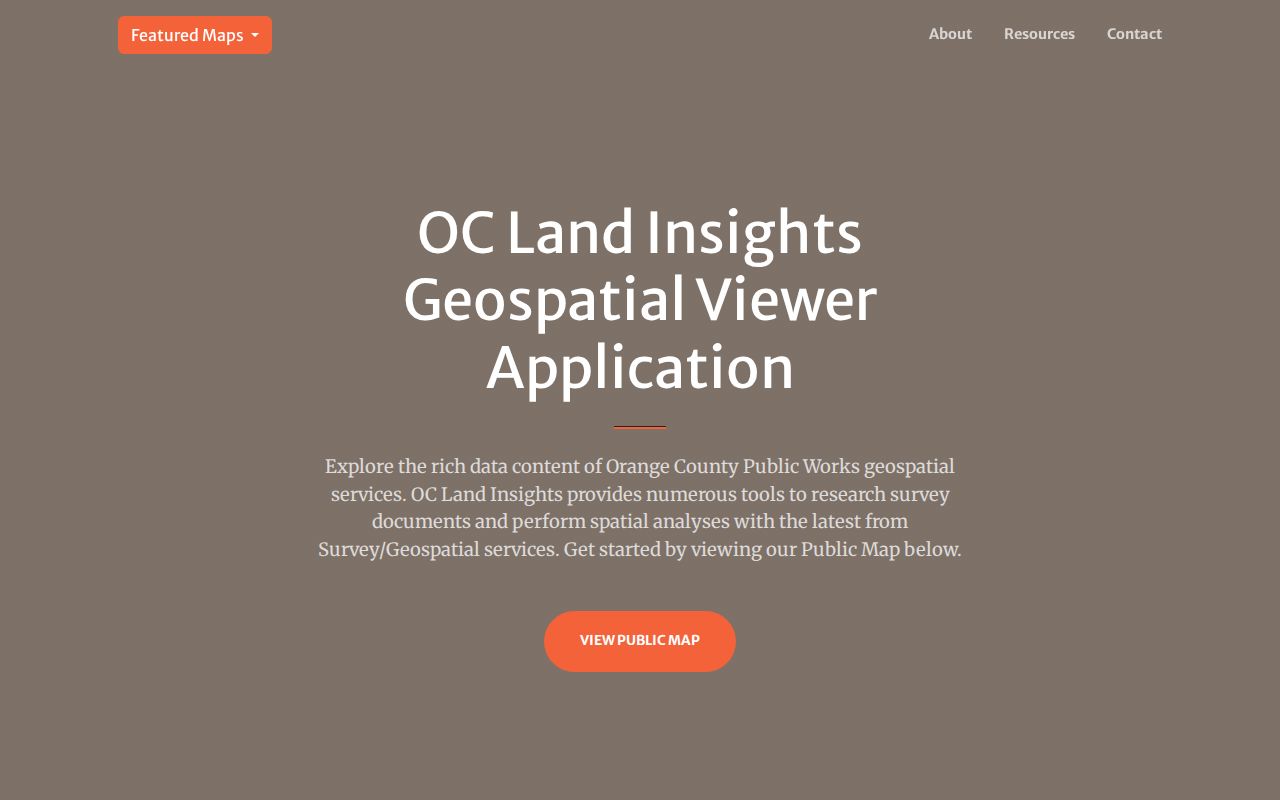
Map clicks narrow the record trail to a parcel and APN. The deed, tax, and city records still need their own custodian checks.
Orange Voter Lookup Limits
California voter data is often mistaken for the missing public resident roll. The OC Vote Voter Lookup Tool is a self-service identity check. It asks for first name, last name, date of birth, and a driver-license, state-ID, house-number, or ZIP verification step as the flow requires. A matched voter can see status, ballot status, history, and selected registration details in the personal dashboard.
The general public cannot enter an Orange street and receive every registered voter. Elections Code section 2194 allows voter information for election, scholarly, journalistic, political, or governmental purposes as determined by elections officials, and commercial use is prohibited. Government Code section 7924.000 protects specified identifiers, signatures, and ordinary home-address disclosure. Safe at Home participants receive added protection.
The controlled alternative is the OC voter-data application. It calls for an original wet signature, requester details, a qualifying purpose, the requested geography and format, payment, and a photo ID for mail requests. Data Central publishes weekly county registration statistics, not a person-level block directory.
The OC Vote Voter Lookup Tool screenshot shows the proper role of the tool. It verifies the voter’s own record; it does not create a public roll.
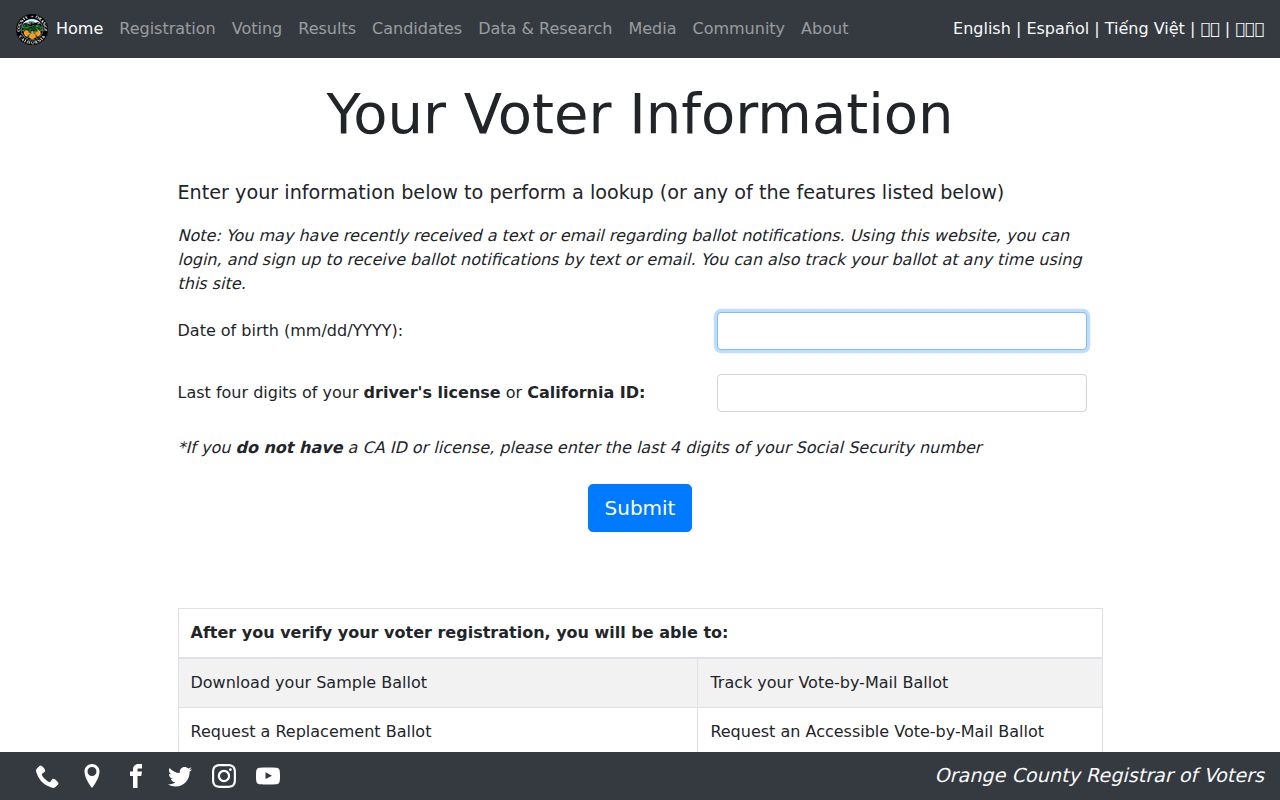
For personal record correction, the voter should contact the Registrar of Voters. A negative self-lookup is not proof that a person never lived at an Orange address.
Current Orange Resident Sources
No single current Orange residents directory covers owners, voters, court parties, historical occupants, business affiliates, and every household member. The practical approach is to select the source whose record relationship matches the question, then cross-check it with a second source.
| Source | What It Lists | Keeper | Access |
|---|---|---|---|
| Secured assessment roll | Parcel, assessed owner or assessee, mailing distinction, values | Orange County Assessor | Free address or APN search |
| Recorded-document index | Grantors, grantees, document type, date, instrument number | Clerk-Recorder | Free index; copies by office or mail |
| Court case index | Party roles, case type, filing events, hearings, disposition where public | Orange County Superior Court | Name search account; case access varies |
| License and business indexes | Professional status, entity affiliation, filing addresses | DCA, SOS, Clerk-Recorder | Free public searches; copies may differ |
| Historical collections | Older households, images, addresses, relationships, local events | Orange Public Library & History Center | Digital search plus staff assistance |
The table is a map of relationships, not a promise of complete coverage. A business address is an affiliation. A court party is connected to a case. A historical directory entry describes a publication year. The Orange residents directory works best when each label stays attached to its source.
For a current one-person question, begin with two independent identifiers and use the specific record keeper. For a whole street, APN and GIS work first. For a past address, the directory shelf, tax rolls, and deed chain take over.
Orange Court Record Matches
The Orange County Superior Court Case Access page separates civil, criminal and traffic, family, probate, and small-claims paths. When the case number is unknown, the Case Name Search accepts a person or business name after sign-in and enrollment. A fee or account requirement may apply. Search results are index or register information, not the complete official file.
Same-name risk is the central issue. Compare case type, filing date, courthouse, party role, and any known case number. The court warns that a result may not accurately associate a name with a case. Probate may identify a decedent, petitioner, or fiduciary. A civil matter may identify a plaintiff, defendant, or judgment event. Restricted, sealed, juvenile, adoption, and confidential family material will not become open through a name query.
| Search input | Person or business choice, last or business name, optional first and middle names. |
|---|---|
| Refiners | Case type or category and filing-date range when the account flow offers them. |
| Typical result | Case number, caption, case type, filing date, parties and roles, events, hearings, and disposition where public. |
| Verification | Match the filing date, party role, case number, and courthouse before treating the name as the right person. |
Registers and indexes may be remotely available while pleadings remain courthouse-only. Federal matters use the PACER system and the Central District of California, not the county portal.
The court access screen is useful because it shows the separation between case categories and a party-name search. That distinction keeps a resident lookup from implying that every court document is online.
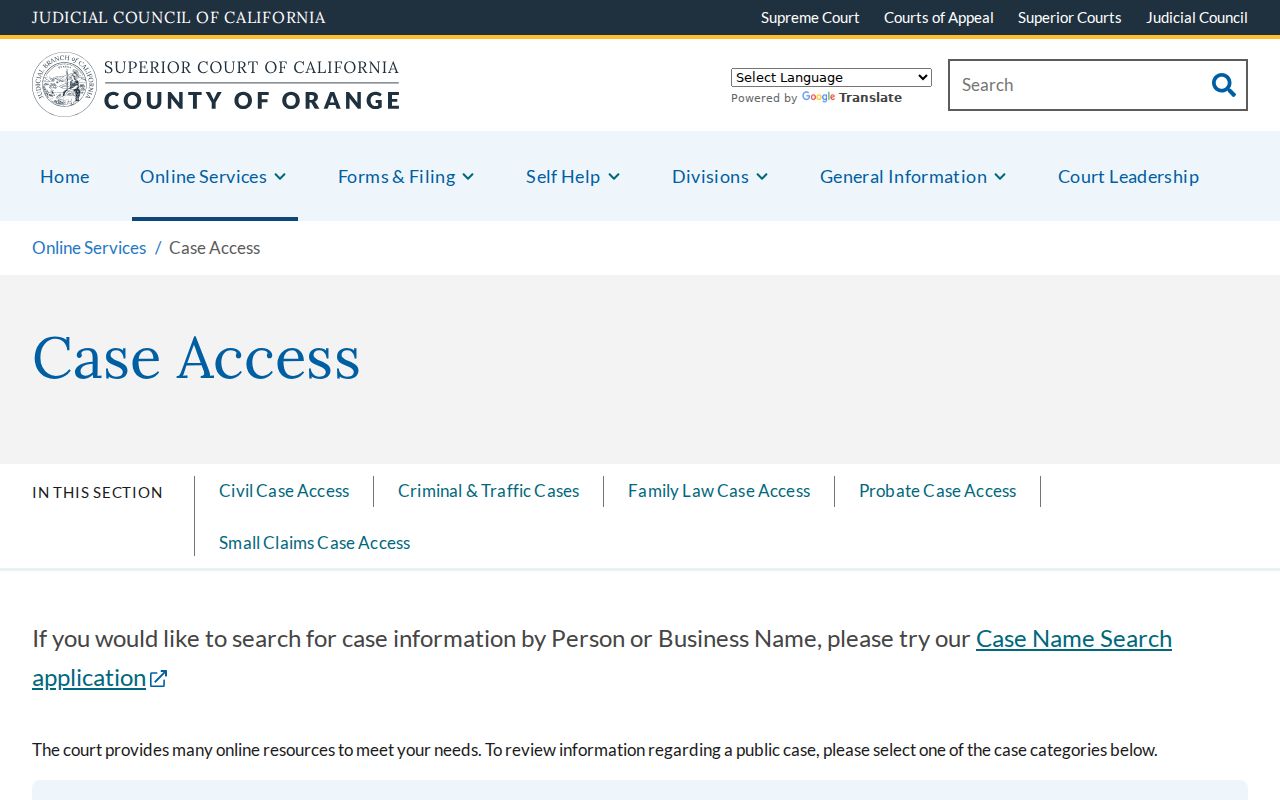
Use the case number and party role as the strongest court anchors. If a document matters, request it from the court records unit under the access rules for that case type.
Orange Vital Records Choices
Birth, death, marriage, and divorce evidence follows a different path from a name search. The Orange County Clerk-Recorder handles county events, while CDPH maintains statewide records and uses mail applications. California does not use a simple rule that makes every certificate open after a fixed number of years. Eligibility, record type, and the difference between an authorized and informational copy control access.
| Record | Custodian | Public option | 2026 CDPH fee |
|---|---|---|---|
| Birth | County or CDPH | Informational copy generally available; authorized copy limited | $31 |
| Death | County or CDPH | Informational copy with redactions; authorized class for identity use | $26 |
| Public marriage | County or CDPH | Informational copy generally available | $19 |
| Confidential marriage | County Clerk | Parties or court order under Family Code rules | $19 where issuable |
| Dissolution certificate | CDPH; court file at Superior Court | Certificate and court file are different records | $18 |
An authorized copy can establish identity for a person in a statutory class, such as a registrant, close relative, court-authorized requester, or qualified official. An informational copy carries a clear legend that it is not valid to establish identity and may include redactions. Mailed authorized applications need a notarized sworn statement. A failed search retains the fee and may produce a Certificate of No Public Record.
Use the county vital-records ordering channel for a known Orange event and CDPH Vital Records for statewide coverage. A historical index can point to an event, but it does not override confidentiality rules for adoption or confidential marriage records.
Orange CPRA Record Requests
When the city created the record, the City of Orange public-records channel is the practical fallback. The City Clerk public-records page accepts an online request or an in-person request at 300 E. Chapman Ave., Orange, California 92866. The city says it determines within ten calendar days whether responsive, disclosable records exist. That is a determination deadline, not a promise that production is complete on day ten.
Describe an existing record with a bounded address, APN, date range, and record class. Permit and property history is online for structures built after 1989. Older property files require a request. Ask for electronic copies where available, and expect inspection to be scheduled separately when the city offers inspection rather than immediate delivery.
- Identify the city department and the exact address or APN.
- Request an existing permit, plan index, certificate of occupancy, inspection card, hearing record, or code case.
- State the date span and preferred electronic format.
- Separate a request for a record from a question that would require staff to create an explanation.
- Read any exemption or redaction notice and ask the custodian about the appeal or clarification path.
The California Public Records Act, Government Code sections 7920.000 through 7931.000, allows a request for identifiable existing records, subject to exemptions and privacy balancing. It does not turn City Hall into a custom Orange resident-roll builder.
Orange's Record Cutoffs
Orange research has three practical cutoffs. The county boundary changes what repository holds an older deed. The recorder’s indexing practice changes which identifier can retrieve a copy. The city’s permit portal changes which property files can be found online. These are not abstract history facts. They tell a researcher when to change tools.
| Date or span | Local change | Search consequence |
|---|---|---|
| 1888 | City of Orange incorporated | Early city-created series may begin before county formation. |
| 1889 | Orange County formed from Los Angeles County territory | Pre-county land and court trails may sit under Los Angeles County. |
| 1900-1934 | Orange historic tax assessment rolls | Owner and property bridge between directories, deeds, and census years. |
| 1982 forward | Recorder instrument number uses recording year plus six digits | Post-1982 copy requests can use the computerized document number. |
| 1989 forward | City property and permit history is online for structures in the covered set | Earlier files move to a CPRA request. |
The 1890 federal population census was largely destroyed nationally. Orange family history therefore bridges 1880 to 1900 with directories, tax lists, deeds, newspapers, and local collections. The newest public population census is 1950 under the 72-year release rule.
Orange History Center Search
The Orange Public Library & History Center is the local bridge between a modern parcel and a past household. Its digital repository offers Text Search, Video Search, Image Search, and Geo Search. A surname may fail in OCR while an address or place search finds a photograph, clipping, tax item, or caption. Repeat the query in more than one mode.
Staff assistance is available at history@cityoforange.org and (714) 288-2465. Ask for Orange city directories, telephone books, reverse or criss-cross volumes, high-school yearbooks, obituary files, newspaper microfilm, and the call number or exact year of a volume. The public catalog did not expose a defensible complete publisher-and-year run, so a careful Orange residents directory entry should cite the volume that was actually inspected.
Local-history digital images for personal use are listed at $5 each in the city’s 2026 master fee schedule. Obituary requests are listed at $25, and extensive research at $50 per hour. Confirm the fee at order time. The goal is a focused request with a surname, address, date window, and likely collection.
The repository’s map and image tools capture the kind of evidence a broad directory cannot. A building caption can suggest a former owner or business, then deeds, tax rolls, and directory entries can test that clue.
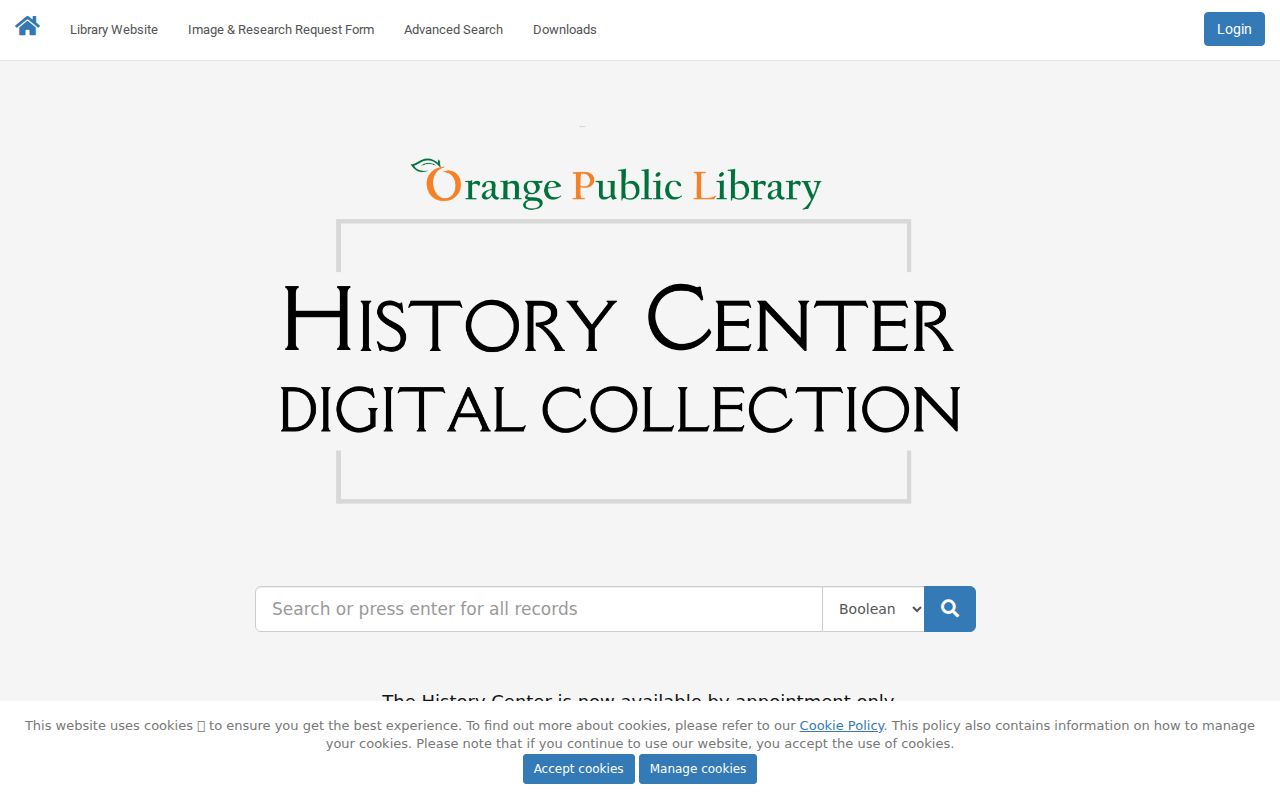
Orange local history becomes more useful when the search terms change with the record: surname in text, street in geography, and building or event in images.
Orange License and Business Records
The California Secretary of State bizfile Online searches an entity name or number and can show status, formation, agent for service, principal or mailing addresses, and filing history. The Orange County fictitious-business-name channel adds the assumed-name layer. Those addresses describe an affiliation, not a residence.
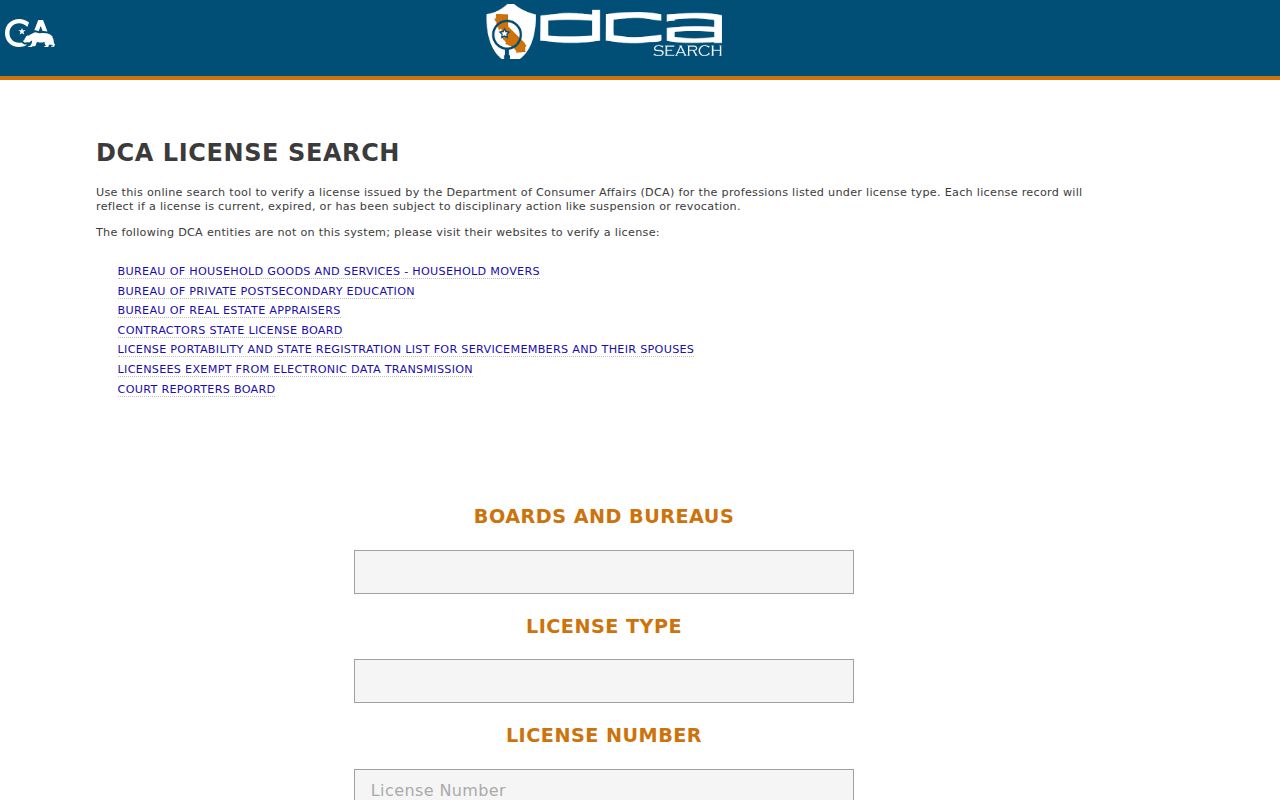
The California Department of Consumer Affairs License Search searches participating boards by board, license type, license number, name, business, city, county, or ZIP. Results can show status, address of record, issue or expiration, and public discipline links where a board exposes them. A specific board may carry deeper records. Use this trail to distinguish two people with similar names, not to turn a license into an Orange resident-record entry.
| DCA search fields | Board, license type, license number, business name, first name, last name, city, county, and ZIP. |
|---|---|
| Business result | Entity number, name, status, jurisdiction and date, agent, principal or mailing addresses, and filing history. |
| Use as an anchor | Pair a license or entity number with a city permit, deed, court case, or historical source. |
The California license search screen below is one of the stronger name disambiguation tools because it supplies a credential number and status rather than only a loose name match.
Orange city permits can add a property link for an applicant, contractor, architect, or owner. The named party should still be described by that role.
Historical Orange Residents Directory
Printed city directories are the closest historical form of an Orange residents directory. The History Center can identify the exact title, publisher, year, territory, call number, and whether a reverse street section exists. Ask staff before claiming a full run because the public catalog did not expose a complete year list. Telephone books, yearbooks, church anniversary books, newspapers, and school records can fill gaps, but each has its own access rule and scope.
A householder entry can connect a surname to an address, occupation, spouse notation, or owner mark for one canvass year. A reverse or criss-cross section changes the order to street and number, which makes it useful for a past address. Read the abbreviation key first. Then compare multiple years, released census schedules, deeds, tax rolls, and obituaries. The Orange city directory collections page keeps that historical-shelf method separate from current parcel work.
Disappearance from one directory is not proof of death. A person may have moved, been missed by the canvass, used a different spelling, or remained unlisted. The best directory research records the gap and tests it with another source.
Orange Resident Record Privacy
Public record access has boundaries. California’s Safe at Home Address Confidentiality Program serves qualifying survivors and threatened participants with a substitute mailing address and a confidential voter process. The program is described by the California Secretary of State and Attorney General materials and is tied to Government Code sections 6205 through 6211. It does not automatically erase older public records, but it can prevent a protected address from being treated like an ordinary search result.
California residents can also review the state’s DROP deletion platform. As of January 1, 2026, one request can reach registered data brokers, with required processing beginning August 1, 2026. Deletion rights have exemptions, and they do not change the source record held by a county office, court, or archive.
Lawful personal use. Orange records are for legitimate research, family history, civic understanding, and personal safety. Never use a directory result to stalk, threaten, harass, or harm another person.
When a record seems wrong or too revealing, take the issue to the custodian that created it. A search result cannot correct an assessor roll, court index, voter file, or recorded document on its own.